 Ελληνικά
How do storage heaters work?
Created on: 2019-09-19
How storage heaters operate. The differences between static and dynamic storage heaters.
The operating principle of storage heaters is based on storing thermal energy during off-peak hours using low-cost night-time electricity and releasing it gradually throughout the day. In this way, they help save both energy and money by taking advantage of reduced electricity rates.
The operation of storage heaters is quite simple and is based on two key parameters: charging and discharging.
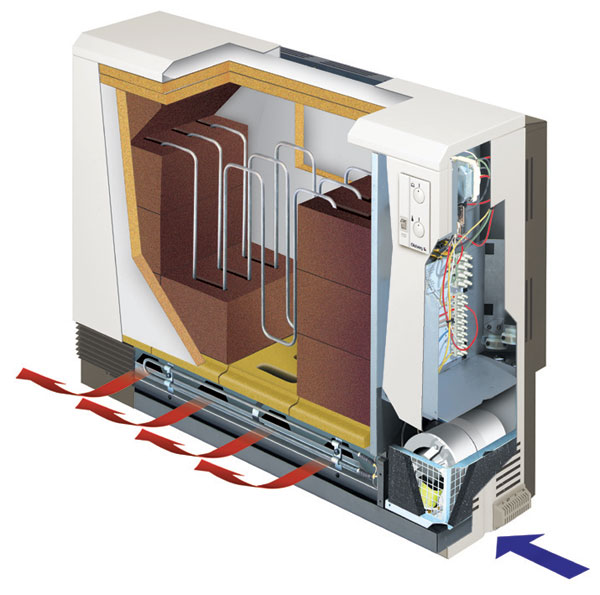
Charging refers to the amount of energy we wish to store in the heater. During off-peak hours, electrical energy is converted into heat through the heating elements and stored in high–heat–retention ceramic bricks. Thanks to the advanced ecological insulation used in modern storage heaters, this energy remains trapped inside the unit, allowing it to be released and managed throughout the day. Users can decide both when and how much to charge the heater. From the electrical control panel — where a simple automation system is installed — the charging time is set, while the control dial on the heater itself allows adjustment of the charging level.
Discharging refers to the amount of stored heat that is released from the unit, and it takes place in two different ways: For dynamic storage heaters, discharge is controlled by a room thermostat mounted on the wall of the space where the unit is installed. For static storage heaters, discharge is regulated by a thermostat located directly on the heater itself.
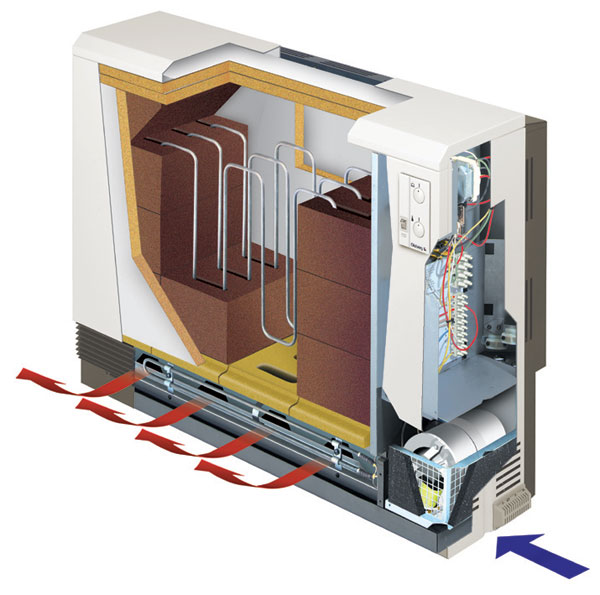
The difference between dynamic and static storage heaters lies in the way they release stored heat into the room. Dynamic storage heaters deliver heat through a low-noise fan that circulates warm air evenly throughout the space. The fan is controlled by a room thermostat, allowing you to adjust and maintain your desired room temperature with precision.

Static storage heaters do not have a fan; instead, they release stored heat through natural air convection via an internal warm-air channel. Cool air enters from the bottom of the unit, is heated as it passes through the channel, and rises naturally to exit from the top, warming the room. The airflow inside the channel is regulated by a built-in thermostat, allowing you to adjust and maintain the desired room temperature with ease.
Storage heaters provide a particularly comfortable and high-quality form of heating. With the ongoing rise in oil prices and the inconveniences associated with fuel-based heating systems—compared to the lower-cost night electricity tariff—these units have become an increasingly popular choice.
For more information or to purchase a storage heater, please contact Zesta.gr.