 Ελληνικά
How do dehumidifiers work?
Created on: 2015-02-27
Find out about the different types of dehumidifiers, how they work, and which one best fits your needs.
Dehumidifiers’ Operation: There are two main types of dehumidifiers, each based on a different operating principle. The first type is the compressor dehumidifier, while the second is the desiccant dehumidifier, which uses a zeolite drying element. Desiccant technology is a more recent and advanced development compared to the traditional compressor-based design.

Compressor dehumidifiers: The operating principle is based on the compression of a refrigerant fluid by a compressor that lowers the temperature of the condenser, which in turn cools the coils. The room air is drawn in through the unit’s filter by a built-in fan and passes over these cooled coils. As the air temperature drops below the dew point, the water vapor it contains condenses into liquid form and is collected in the unit’s water tank—or drained directly through a hose. Finally, the dry air is reheated to room temperature and released back into the space.
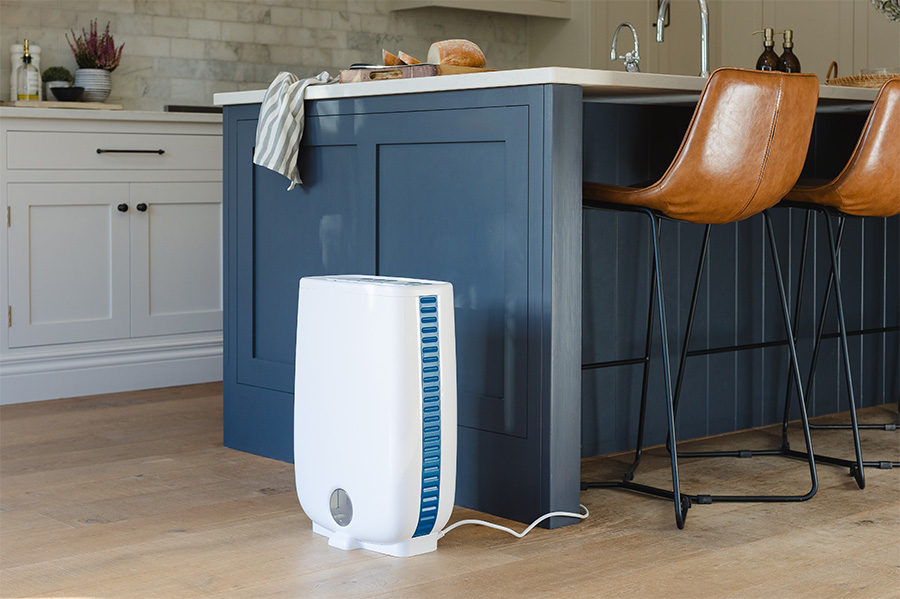
Desiccant dehumidifiers (with zeolite technology): The operating principle is based on the use of zeolite, a desiccant material with the natural ability to absorb moisture from the air. The dehumidifier draws in room air using its fan, passes it through a filter, and directs it over a slowly rotating zeolite wheel. The moisture is captured and is then turned into water, by heating the zeolite. Water is finally collected in the tank or drained away via a hose and the processed air is returned to the room warmer and drier. Desiccant dehumidifiers with zeolite technology include the Meaco DD8L.


Watch a video on how the desiccant dehumidifier works using zeolite.
Differences, advantages & disadvantages: The main difference between the two technologies is that compressor dehumidifiers do not perform efficiently in spaces that are not adequately heated (below 16–17°C), whereas desiccant dehumidifiers operate at full efficiency even at low temperatures. This happens because the inside of a compressor dehumidifier must be colder than the surrounding air. The colder the room, the harder the unit needs to work to create the required temperature difference for moisture removal. When room temperatures drop to around 15°C, compressor models are programmed to enter a defrost cycle to prevent ice buildup on the coils — a process that reduces their effectiveness. However, in well-heated spaces, compressor dehumidifiers perform reliably while keeping energy consumption low.